


There’s a specific moment most men can point to. A photo from a work event, a video call where the camera was slightly too honest, a morning where the mirror just didn’t cooperate. The jaw isn’t where it used to be. The skin under the chin has started doing its own thing. The lines around the mouth have stopped being lines and started being features. It’s not dramatic. It’s just enough to be annoying—and in New York, annoying has a way of becoming a problem.
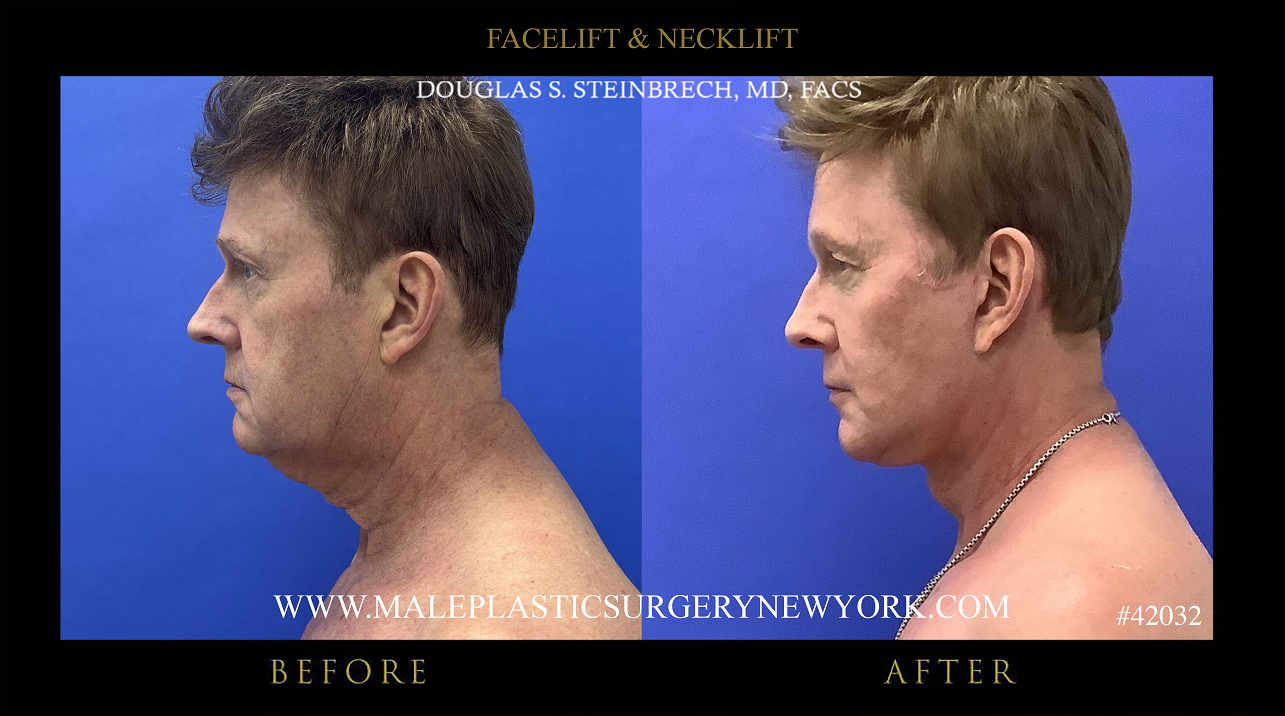
A facelift fixes the underlying structure. Not the surface. Not temporarily. The actual muscles, fat, and skin that have shifted over the years get repositioned, tightened, removed where necessary, and sutured back into a configuration that looks like you did fifteen years ago. Men who’ve had it done don’t look like they’ve had work done. They look like they sleep well and live clean.
Dr. Steinbrech at Alpha Male Plastic Surgery has been doing this—only this, only on men—for years. The practice exists because the standard facelift was designed around the female face and men kept getting results that looked wrong on them. Too smooth. Too pulled. The beard line distorted. The jawline too soft. Dr. Steinbrech built something different.

What Is a Male Facelift?
Rhytidectomy is the clinical term. What it actually involves: the platysma and deeper facial muscles get repositioned and tightened, excess fat is removed or redistributed, and the overlying skin is re-draped so it sits correctly against the new underlying structure. The whole thing is calibrated to produce a face that looks naturally younger—not surgically altered.
On a man, that calibration is different than it is on a woman. The skin is thicker and heavier. The fat sits differently. There’s a beard line that has to be accounted for in every incision decision—get that wrong and the patient spends years dealing with hair growing in the wrong place or a hairline that’s visibly been moved. The aesthetic target is angularity and definition, not smoothness. These aren’t minor differences. They require a surgeon who has actually thought about them, not one who occasionally operates on men between a full schedule of female patients.
What a Facelift for Men Actually Addresses
Jowling along the lower face—the tissue that descends and pools along the jawline, softening what used to be a defined edge. Nasolabial folds that have gone from subtle to permanent. Loose skin beneath the chin and along the neck that has blurred the line between jaw and throat. Facial fat deposits that have migrated south from where they used to sit. Deep lines near the temples and eyes. A general loss of structural tension across the mid and lower face that makes a man look tired even when he isn’t.
None of this is inevitable in the sense that it has to stay. It’s just anatomy doing what anatomy does over time. A facelift reverses the structural component of that—not all of it, not permanently, but significantly and for a long time.

How the Surgery Works
General anesthesia or IV sedation. Dr. Steinbrech determines which based on the scope of what’s being done and the individual patient’s situation—it gets discussed and decided before anything else.
There are three approaches depending on what the patient actually needs:
Traditional facelift—The full version. Incisions start at the temples, follow the natural crease down to the front of the ear, wrap around the ear cartilage, continue behind the ear, and end at the lower scalp near the hairline. Sometimes a small additional incision goes under the chin. Through these, fat gets sculpted, deeper tissues get repositioned, and the skin gets re-draped and trimmed. This is the approach for men dealing with significant aging across the face and neck. It’s comprehensive and the results reflect that.
Limited-incision facelift—Shorter incisions around the ear and temples. Better suited for men with more targeted concerns—early jowling, specific areas around the eyes or mouth—who aren’t yet candidates for a full lift or don’t need one. Less surgery, faster recovery, more focused result.
Neck lift component—The neck and lower jaw are frequently addressed alongside the face in the same procedure. For men whose aging is concentrated there, combining both in one surgery makes more sense than staging them separately. The incisions for the neck component encircle the earlobe and extend behind the ear to the lower scalp.
All incisions get closed with sutures or tissue adhesive. Placement is deliberate—inside the hairline, along the ear’s natural contours, in locations that become undetectable as healing progresses. The beard line is mapped before a single incision is made.
The procedure runs around two hours. More complex cases take longer.
Adding Other Procedures to Facelift
Some men come in for a facelift and leave having addressed more than they originally planned—not because they got upsold, but because the consultation surfaced something they hadn’t fully considered.
Eyelid lift: The eyes age independently of the lower face and a facelift doesn’t reach them. Men dealing with heavy upper lids, under-eye bags, or significant hollowing around the orbital area often combine blepharoplasty with a facelift. The recovery overlap makes doing them together more practical than staging them months apart.
Are You a Candidate?
Men in their forties, fifties, and sixties make up most of the facelift patients at this practice. But age is a rough guide at best. What actually determines candidacy is what the face shows—some men in their late thirties have meaningful laxity, some men in their late sixties are better served by a limited procedure than a full lift.
The baseline requirements: good overall health confirmed by your primary physician, non-smoker or willing to quit well before surgery, skin that still retains enough elasticity to respond well to repositioning. And realistic expectations—a facelift makes you look like a significantly better version of yourself, not a different person.
Men who are primarily concerned with the upper face—the brow, forehead, upper eyelids—should know that a facelift doesn’t address those areas. Additional procedures handle the upper third. That gets sorted out during consultation.
Not everyone who comes in is ready for surgery right now. Some need to address their weight first. Some have health factors that need to be managed before going under anesthesia. Dr. Steinbrech will tell you exactly where you stand—including if the answer is not yet.
Facelift: What It Costs
A male facelift at Alpha Male Plastic Surgery starts at $30,000. Procedures that combine a facelift with a neck lift, eyelid surgery, or additional work run anywhere from $50,000 to over $100,000 depending on scope, anesthesia, and facility fees.
In New York City that range is consistent with what serious facial surgery costs at practices operating at this level. It also reflects the real variation between patients—a man with moderate jowling and decent skin elasticity is a fundamentally different surgical case than a man with extensive laxity across the face, neck, and jaw who hasn’t been happy with his profile in a decade.
Financing is available. It gets discussed at consultation.
The math that matters: a facelift at this level produces results that hold for ten to fifteen years. That’s not a monthly appointment. That’s not something you maintain with quarterly injections. It’s a structural change that, for most men, becomes one of the better investments they’ve made in themselves.

Recovery: What to Actually Expect
Drainage tubes in some cases, removed the day after surgery. Dressings on the incisions. Sutures out around the one-week mark.
The first week is the most uncomfortable. Swelling, bruising, tightness across the face and neck, some numbness—all of it normal, none of it permanent. The face may look uneven or asymmetrical early on. Facial muscles feel stiff. This is the body healing, not something going wrong.
Most of the visible effects resolve within three to six weeks. Sensation comes back gradually over the following months. The scars flatten and fade—in most cases they become genuinely undetectable once fully healed. Shaving near the incision areas behind the ears and neck should be done carefully until the skin is fully healed and no longer sensitive.
Three weeks out, most men are back to their regular routine. Strenuous activity—the gym, anything that significantly elevates heart rate—waits four to six weeks.
The final result, meaning fully settled with all residual swelling gone, shows up at around three to six months. That’s what you’ll have for the next decade or more.
Why This Practice
There are plastic surgeons in New York City who are genuinely excellent. There are also a lot of them. Finding one whose entire practice is men—not men as a category alongside everyone else, but men exclusively—is a different search.
The male facelift requires specific knowledge that doesn’t transfer automatically from operating on women. The beard line. The heavier skin. The different fat architecture. The aesthetic goal—definition and structure rather than softness. Getting these right requires having thought about them seriously over a long career of operating on male faces specifically.
Alpha Male Plastic Surgery was built around exactly that. Every patient is male. Every protocol was developed with the male face as the starting point. Men who come here after consulting elsewhere often say the same thing—that this was the first place where the conversation felt like it was actually about them.

Facelift: Frequently Asked Questions
How long do results last? Ten to fifteen years for most patients. The face continues aging after surgery but from a much better baseline. Stable weight and reasonable lifestyle habits extend longevity. Men who yo-yo significantly in weight tend to see results degrade faster.
Will people be able to tell? If the surgery is done correctly on a male patient by someone who understands male aesthetics, no. The result should look like you looked years ago—not like you had a procedure. The telltale signs of a bad facelift are surgical judgment problems, not inherent to the procedure itself.
What about scarring? Incisions are placed in locations that heal into the natural architecture of the face—inside the hairline, along the ear’s contours, behind the ear. They become difficult to find once healed. The beard line is mapped before surgery to make sure it’s not distorted by incision placement or tissue movement. This is one of the technical areas where experience on male patients specifically makes a measurable difference.
Facelift vs. injectables—what’s the difference? Injectables address volume loss and surface-level concerns. They don’t reposition tissue, tighten muscle, or remove skin. For men with early-stage aging they can be a reasonable starting point. For men with significant laxity and structural loss, injectables won’t get them where they want to go. The two approaches solve different problems—one of them is the right answer depending on where you actually are with your face.
Do I need a full facelift or something more limited? That gets determined at consultation based on what Dr. Steinbrech actually sees—degree of laxity, skin quality, specific areas of concern. He’ll tell you directly which approach fits your situation and why.
Schedule a Consultation
If you’ve been thinking about this and you’re ready to have a straight conversation about what’s actually possible, the consultation is where that starts.
Dr. Steinbrech will look at your face, ask you what’s bothering you, and give you a direct answer about what surgery would involve, what results are realistic, and what recovery looks like for your specific situation. Book here.

 Douglas S. Steinbrech, M.D., F.A.C.S. is a plastic and reconstructive surgeon that specializes in male aesthetics. Dr. Steinbrech is certified by the American Society of Plastic and Reconstructive Surgeons and a diplomate of the American Board of Plastic Surgery.