


Corrective surgery for men at our Manhattan office, from a surgeon who has performed more than 3,000 revisions.
Alpha Male Plastic Surgery treats men in Manhattan whose earlier cosmetic surgery left them with a result they can’t live with: a chest that caved in under the nipple after gynecomastia surgery, abdominal etching that lines up with nothing, a pec implant drifting toward the armpit, a jaw that came out looking less like a man’s. Revision is the second operation that corrects the first. Dr. Douglas Steinbrech, who wrote the textbook Male Aesthetic Plastic Surgery, has done more than 3,000 of them on men, and a large share of his New York patients had their original surgery somewhere else, sometimes in this city, sometimes in another state or another country.
What Makes Revision Surgery Different
The first surgeon operated on tissue nobody had touched before. Layers of skin, fat, and the fascia over muscle came apart the way they’re supposed to, along natural seams. By the time a man comes to us for revision, those seams have healed together with scar. Dr. Steinbrech has to free that scar from nerves, blood vessels, and muscle a few millimeters at a time before he can correct anything, and male tissue adds its own complications. Men’s skin is thicker and doesn’t shrink down over a new contour easily, the beard area bleeds more during facial surgery, and male fat in the chest and flanks is tougher and more fibrous than female fat. A revision done like a routine first operation tends to fail a second time.
Revision Procedures at Our Manhattan Office Focus Specifcally on Men
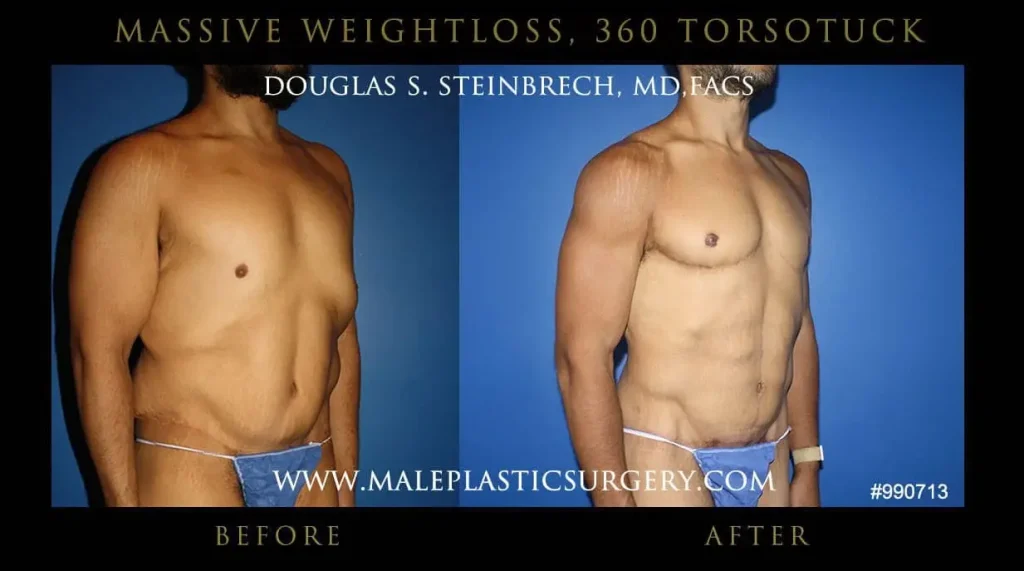
Gynecomastia gone wrong in one of two directions. Either the first surgeon removed fat with liposuction and left the firm gland behind the nipple, so the puffiness returned, or he removed too much tissue right under the nipple and left a crater where the areola sinks in and sticks to the muscle. Leftover gland can be cut out through a small incision at the edge of the areola. A crater takes more work: releasing the scar that tethers the areola down, then rebuilding the missing volume with nearby tissue or grafted fat.
Etching that doesn’t match the man underneath it. The grooves were drawn where a six pack should be on an average body instead of where this patient’s tendon bands actually sit, so when he flexes, his real abs show up next to the fake ones. Correction involves subcision to release skin that has scarred onto the muscle sheath, fat grafting using Dr. Steinbrech’s BodyBanking® principles to fill hollows, and new definition marked while the patient flexes.
Pec implants that moved or hardened. Pockets cut too wide let an implant slide toward the armpit, and pockets cut too high push it up toward the collarbone, where the edge shows through. A tight scar capsule can make an implant feel like a puck. Depending on the cause, the fix might be releasing or removing the capsule, stitching the pocket smaller, swapping for a custom implant, or taking the implants out and building the chest with fat instead.
Faces that lost their angles. Rounded jaw corners, a chin implant that shifted, a facelift pulled sideways toward the ear, or sideburns dragged up and back by a poorly placed incision. Dr. Steinbrech can replace failed implants with custom ones designed from a CT scan of your own jaw, reset the deeper facial layer on a more vertical line that suits a male face, and plan incisions around the hairline and beard.
Eyelids and noses taken too far. Upper lids with so much fat removed that a tired look turned into a startled one, lower lids pulled down off the eye, a nose reduced until the tip pinched and the airway started collapsing. These are rebuilt with fat grafts, tendon tightening at the corner of the eye, and cartilage grafts, often from the rib, since the first surgery may have used up the septum.
Getting Your Records From the First Surgeon
Operative notes help a revision surgeon enormously, because they show which implants, grafts, and tissue layers were involved. Under federal privacy law you have a right to copies of your own medical records, so you can request them directly from the practice that did your first surgery, even if you’d rather not talk to that surgeon again. A short written request to the office is usually enough. If the records are incomplete, or the practice has closed, Dr. Steinbrech still evaluates and operates on revision cases regularly without them.

When Your First Surgery Was Done Abroad or Out of State
Plenty of men in New York traveled for their original procedure because the price was lower or a friend recommended someone, and only found out later that there was no easy way to go back for a follow up. Those cases are common in revision practice. Bring whatever paperwork you have, including implant cards, discharge papers, and photos from before the first surgery. Implant cards matter more than people expect, since they tell the surgeon the exact size and type of what’s inside you.
How Long to Wait, and Why
Fresh scar is packed with blood vessels, stiff, and still contracting. Operating through it too early means more bleeding and a strong chance the new scar tightens all over again. For most men, Dr. Steinbrech wants 6 to 12 months between the last operation and the revision. A complicated nose or a large liposuction repair can call for as long as 18. A few problems shouldn’t wait at all: an infection, an implant working its way through the skin, or a lower lid sagging so far that the eye no longer closes properly all need prompt attention.
Your Consultation in Manhattan
Dr. Steinbrech does every revision consultation himself. He’ll go through your history and any records you bring, compare photos from before your first surgery with what he sees now, and use 3D imaging to map the area and measure the difference between the two sides. The physical exam carries the most weight. He checks how thick the remaining tissue is, where scar is pinning skin down, and whether there’s enough fat elsewhere on your body to graft if you need it.
Men come into these appointments angry, embarrassed, or simply done trusting surgeons, which is understandable. The conversation is direct. You’ll hear what went wrong, what your tissue can still support, and what improvement is realistic. Sometimes the answer is to wait. Occasionally it’s that another operation wouldn’t help, and he’ll say so.
Planning Time Off Around a New York Job
Revision recovery runs longer than recovery from a first operation, because there’s scar to dissect through and the tissue takes more time to settle. Swelling generally lasts 20 to 30 percent longer. Most men still need somewhere between 7 and 14 days away from work, depending on the procedure, and many schedule surgery so that time overlaps with a holiday week or a planned vacation. Compression garments sit under a suit without anyone noticing, which makes the return to the office easier than most men expect.

What a Revision Can and Can’t Do
No honest surgeon promises a perfect revision. A second operation starts with less tissue, a disrupted blood supply, and scar where healthy tissue used to be, and in overcorrected cases some of what was removed isn’t coming back. What revision can do is release tethered skin, rebuild lost volume, reposition or replace implants, and restore masculine angles, which for most men is a dramatic improvement. Some cases need more than one stage. All of it is discussed before anything is scheduled.
Questions New York Patients Ask
How do I get my records from the surgeon who did my first surgery?
Send a written request to that practice asking for your operative report, implant information, and any photos in your chart. You’re legally entitled to copies of your own records, and you don’t need to explain why you want them or speak with the surgeon. Offices can charge a reasonable copying fee. If the practice has closed or the records are thin, bring what you have, since Dr. Steinbrech routinely works without complete files.
Can you fix surgery that was done in another country?
Yes. Men regularly come to our Manhattan office after procedures performed abroad, often because follow up care with the original surgeon was impossible. Bring any paperwork you were given, especially implant cards, plus photos from before the first surgery. Those details help Dr. Steinbrech understand exactly what was done, though he can still evaluate you and build a plan if your documentation is limited.
How much time will I need off from work?
Most men take between 7 and 14 days away from the office, depending on which area is being revised and how much correction is needed. Swelling settles more slowly after a revision than after a first operation, typically by about 20 to 30 percent, but compression garments hide easily under business clothes. Many patients line up surgery with a holiday week so they miss as few working days as possible.
Do I really have to wait 6 to 12 months?
For most revisions, yes. Scar tissue in the first months after surgery is full of new blood vessels and still tightening, so operating through it raises bleeding risk and makes it more likely the new scar contracts again. Complex nose and liposuction revisions can need up to 18 months. Infections, exposed implants, and eyelid problems that affect the eye are exceptions and should be seen right away.
Will a revision cost more than my first surgery did?
Often it does, because revisions take longer in the operating room and involve more complex work, such as releasing scar, grafting fat, or replacing implants. Pricing is set individually after Dr. Steinbrech examines you and decides what the correction will actually involve. You’ll get a specific quote at your consultation, and he’ll explain what drives the number before you commit to anything.
Can I start with photos before booking a visit?
Yes. If you live outside Manhattan or simply want an opinion before coming in, you can send photos securely for a private virtual review. Dr. Steinbrech will look at what was done, give you a sense of whether revision makes sense, and tell you whether an in person consultation is the right next step. Many out of town patients start this way before planning a trip.
Schedule a Confidential Revision Consultation in Manhattan
Dr. Steinbrech sees every revision patient personally at Alpha Male Plastic Surgery’s Manhattan office. Call 646.921.3052 or use the form on this page to book, and bring any records you have from your first surgery. If you’re outside New York, send photos for a private review first.
 Douglas S. Steinbrech, M.D., F.A.C.S. is a plastic and reconstructive surgeon that specializes in male aesthetics. Dr. Steinbrech is certified by the American Society of Plastic and Reconstructive Surgeons and a diplomate of the American Board of Plastic Surgery.